AI Doesn't Get Tired: What AI-Driven Medicine Means for Rare Disease Care
From better monitoring to faster science, and why commercial playbooks are the slowest part of the system
The Night Shift Problem
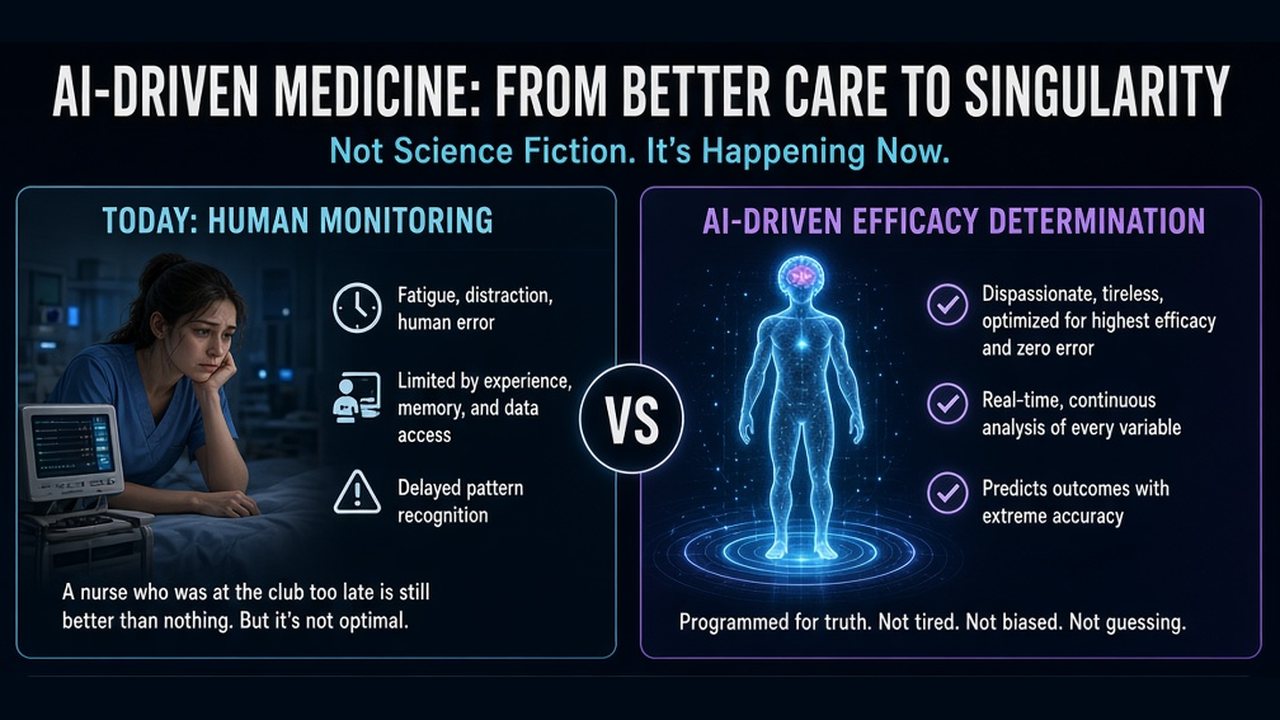
Picture a nurse at the end of a long night shift, watching a monitor. She is skilled, she cares, and she is tired. She will catch most of what matters. Not all of it.
That picture describes most of medicine, and rare disease even more. The signals we need are faint, scattered across a handful of patients, and spread over years. The people who interpret them are experts, and there aren't many of them. Each has a full clinic and a limited view of data held in other hospitals and countries.
Last month I wrote about DeepRare, the agentic diagnostic system published in Nature, and what it could do to the diagnostic odyssey. Since then I've been thinking about a wider question. If AI can help find a rare disease patient, what else changes when it sits next to the clinician, the safety team and the market access lead?
I've spent more than 22 years in rare disease commercialisation, and my answer is: quite a lot, and sooner than most launch plans assume.
From Human Monitoring to Continuous Analysis
Humans are good at judgment and bad at vigilance. We get tired. We get distracted. We see the pattern we've seen before and miss the one we haven't. That's how attention works, not a criticism of clinicians.
AI has the opposite profile. It doesn't tire, it doesn't get bored by the thousandth data point, and it can look at every variable at once. It also has weaknesses of its own: it can be confidently wrong, it inherits the bias of its training data, and it needs a human to decide what a signal means for a particular patient. Claims of "zero error" belong on posters, not in clinical practice.
In rare disease, the combination matters more than in common conditions, for three reasons. This is my commercial and clinical interpretation, not a finding from a single study.
Small-n pattern recognition
An expert centre in Belgium may follow a few dozen patients with a given ultra-rare condition. No physician sees enough cases to build intuition for slow, atypical progression. A system that can compare a patient against everything recorded across a network of centres, such as the European Reference Networks, can see patterns no individual clinician could.
Remote and home monitoring
Many orphan therapies are now given at home or in outpatient settings. Wearables, home spirometry, digital symptom diaries and app-based patient-reported outcomes generate continuous data. Continuous analysis can flag deterioration or non-response weeks earlier than the next scheduled visit.
Patient support programmes
Patient support programmes (PSPs) collect adherence, logistics and outcome data, but most were designed as service operations, not learning systems. AI can turn PSP data into early warnings: a patient missing infusions, a family struggling with a home-care schedule, a region where follow-up is slipping. Under GDPR and pharmacovigilance rules, every one of those uses needs a clear purpose, consent and governance. The opportunity is real, and so is the compliance work.
The clinician stays in charge. What changes is what they can see. AI won't replace the expert at the rare disease centre. It gives that expert a view across patients, countries and time that no human could hold in memory.
Side Effects: From History to Simulation
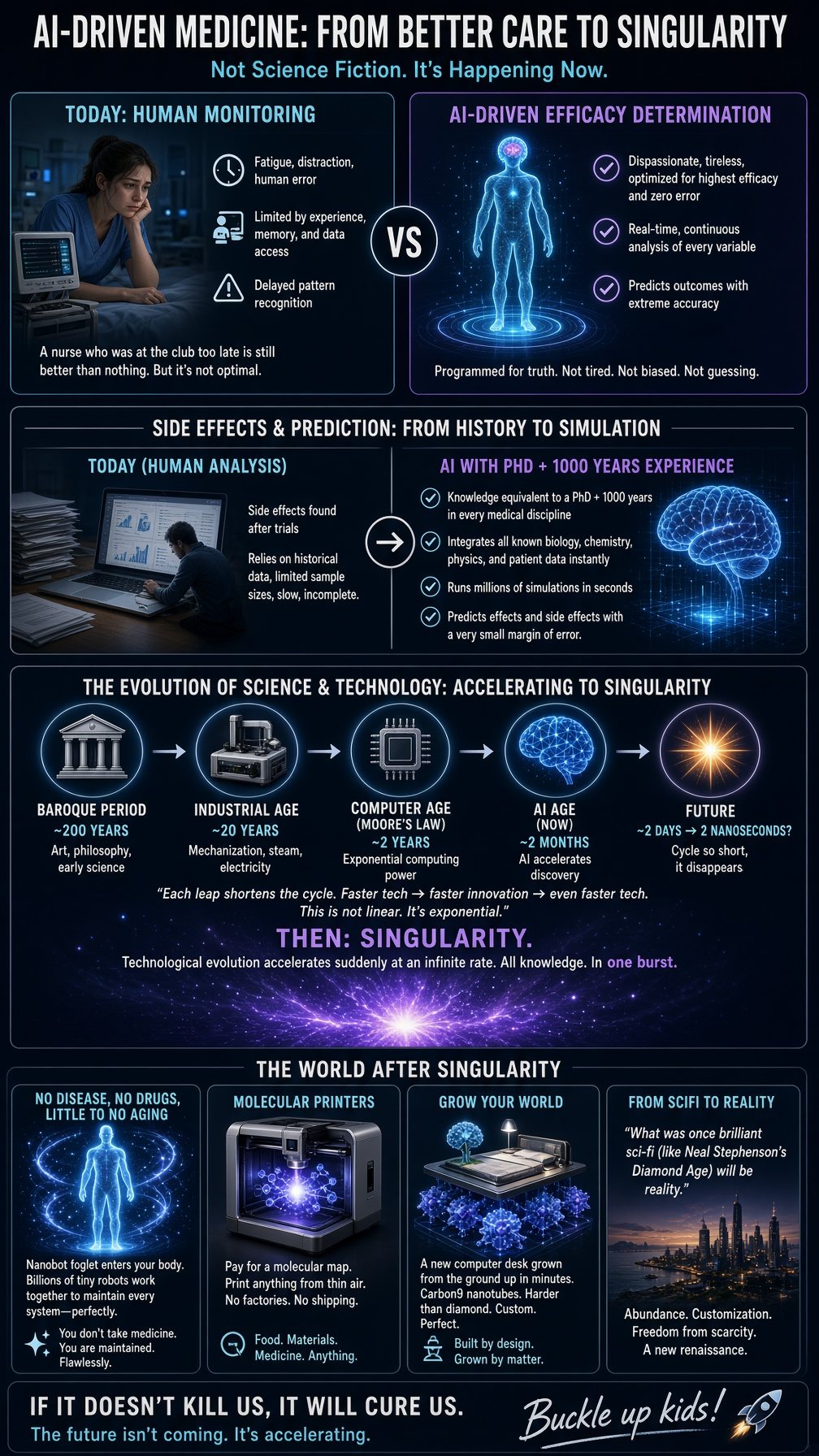
Today, most safety knowledge is found after the fact. Trials are small, especially in rare disease, so uncommon adverse events often show up only after approval, through spontaneous reports, registries and post-authorisation studies. We learn from history, slowly, with incomplete data.
That model fits orphan drugs and advanced therapies badly.
- Trials are tiny. A pivotal study of a few dozen patients can't detect a one-in-a-thousand event. Hence the post-authorisation obligations attached to so many orphan approvals.
- Follow-up is long. For gene therapies and genome editing, the US FDA's guidance on long-term follow-up recommends monitoring for up to 15 years for some product types. Europe's expectations for ATMPs are similarly long. That's a decade or more of real-world evidence (RWE) to collect and analyse.
- Signals arrive late and hurt. The serious liver injury cases reported with AAV gene therapy in 2025 showed how a safety signal in a small, vulnerable population can change a product's trajectory within weeks.
The direction of travel is from detection to prediction. In-silico models that combine biology, chemistry, pharmacology and patient data can, in principle, flag likely risks before patients are exposed, and help decide who should be monitored more closely. My view, clearly interpretive, is that these tools will first earn trust as aids to signal detection in registries and PSP data, and only later as accepted predictive evidence in regulatory submissions. The EMA's 2024 reflection paper on AI across the medicinal product lifecycle points the same way: AI is welcome, but the sponsor stays responsible for validating it.
For commercial teams, this isn't just a safety department topic. A credible, AI-supported long-term follow-up plan is part of the payer conversation. When a payer is asked to fund a one-time therapy with uncertain durability, better evidence generation after launch can be the difference between a managed-entry agreement and a refusal.
The Cycles Are Getting Shorter
The infographic that started this article shows a simple idea: each era of science and technology arrives faster than the last. Centuries of early science. Decades of industrialisation. The roughly two-year rhythm of Moore's law in computing. And now AI, where meaningful capability jumps seem to come in months. The exact intervals are a framing, not a measurement, but the direction is hard to argue with.
Rare disease is feeling it directly.
- Gene editing has moved from lab to clinic. The first CRISPR-based therapy, exa-cel (Casgevy), was approved in the UK and the US at the end of 2023 for sickle cell disease and transfusion-dependent beta-thalassaemia. In 2025, a team in Philadelphia reported in NEJM a personalised base-editing therapy designed and given to a single infant with CPS1 deficiency within months.
- Diagnosis is being rebuilt by AI. Systems like DeepRare suggest that phenotype-driven diagnostic reasoning can reach a level of accuracy that changes how fast patients are found.
- The rules are changing too. The EU's joint clinical assessments under the HTA Regulation started in January 2025 for oncology medicines and ATMPs, and will cover orphan medicines from 2028. The EU AI Act and the European Health Data Space are phasing in over the coming years.
Now compare that with how most rare disease commercial teams still plan. A three-year launch plan, built from a template designed for chronic, repeat-prescription products, with patient numbers from epidemiology literature that may be ten years old. Forecasts updated once a year. Field teams sized on call frequency.
My practitioner judgment: in rare disease, the science cycle now moves faster than the commercial planning cycle. That gap is where launches go wrong. Not because the product fails, but because the organisation around it was designed for a slower world.
A Brief Look at the Horizon
Some people take the acceleration argument all the way to a technological singularity: a point where progress becomes so fast that it outruns our ability to predict it. Ray Kurzweil has placed it around 2045. Science fiction imagines the world after: abundance, therapies built to order, a body maintained rather than repaired.
I find those ideas useful as a horizon, and I'd be careful with them as a plan. Nobody can promise the end of disease or of ageing, and rare disease patients have heard enough overpromising. What I take from the horizon is narrower: the direction is towards more personalised, earlier and more continuous care. That direction is already visible. The destination isn't.
So let's come back to what matters this year.
What Commercial Teams Should Do Now
If I were advising a rare disease company preparing a European launch in the next two to three years, this is where I'd focus. It's practitioner judgment from orphan launches, not trial evidence.
1. Plan for faster patient identification. If AI-supported diagnosis shortens the diagnostic odyssey, the diagnosed pool may grow faster than your forecast assumes, and in different places. Build forecasts that can be updated quarterly, and map which centres and genetic labs are adopting diagnostic AI. (This sits at the heart of our approach to orphan drug launches in Europe.)
2. Design PSPs as data systems, not only services. Decide at the start what the programme should learn, how data flows to medical and safety teams, and how consent and GDPR are handled. Retrofitting this later is expensive and sometimes impossible.
3. Make long-term evidence part of the value story. Payers will ask how you'll prove durability and safety over years. An evidence plan that uses registries, RWE and AI-supported signal detection belongs in the market access dossier, not only in the risk management plan.
4. Partner with expert centres on their tools. Rare disease centres are already experimenting with AI for diagnosis, monitoring and data sharing. Companies that support those efforts, within compliance rules, become partners rather than vendors.
5. Build leadership that can move at the speed of the science. Many emerging biotechs reach Europe without a country organisation, and with a playbook written for a slower era. An experienced interim or fractional commercial lead can set up access, the centre network and the evidence plan, then scale as the market shows itself. (That's the model behind our interim commercial director work in the Benelux.)
Key Takeaways for Rare Disease Commercial Teams
- AI adds vigilance, not authority. It sees across patients and time; the clinician still decides. Position your support around that.
- Safety is moving from history to prediction. Long follow-up for orphan drugs and gene therapies makes AI-supported RWE a commercial asset, not just a regulatory duty.
- Your forecast is probably too slow. Faster diagnosis changes patient numbers. Update models more often than once a year.
- PSPs are your learning engine. Design them for data, consent and insight from day one.
- The gap is organisational. The science is accelerating. The biggest launch risk is a commercial model built for a slower world.
The Future Is Speeding Up
There's a line on the infographic I keep thinking about. Stripped of its cheek, it says this: if we manage AI well and don't let it overwhelm us, it can make care better. I agree with that, with the emphasis on manage.
Rare disease has always been where medicine tries things first. We were early with orphan incentives, early with gene therapy, and we're early with diagnostic AI. We'll be early with AI-driven monitoring and safety prediction too.
The future isn't something we're waiting for. It's already accelerating. The teams that adapt their commercial models now will be the ones still standing next to patients when it arrives.
Sources
1. Zhao et al. (2026). "An Agentic System for Rare Disease Diagnosis with Traceable Reasoning" (DeepRare). Nature, 651:8106. Discussed in detail in our February 2026 article.
2. US FDA. Long Term Follow-Up After Administration of Human Gene Therapy Products. Guidance for Industry, January 2020.
3. European Medicines Agency. Reflection paper on the use of artificial intelligence (AI) in the medicinal product lifecycle. Adopted September 2024.
4. Regulation (EU) 2021/2282 on health technology assessment (joint clinical assessments applicable from 12 January 2025).
5. Musunuru K, et al. "Patient-Specific In Vivo Gene Editing to Treat a Rare Genetic Disease." N Engl J Med, 2025.
6. US FDA and UK MHRA approvals of exa-cel (Casgevy), November–December 2023.