Not Only a Motor Neuron Disease: What Muscle Stem Cells Mean for SMA's Next Chapter
A new study in Brain links the loss of muscle stem cells to motor neuron loss, and that changes the long-term SMA story commercial teams tell
The Story We Got Used To
For most of the past decade, spinal muscular atrophy has had a simple story. A child lacks enough SMN protein, motor neurons in the spinal cord die, and muscles waste because nothing tells them to work. Give back SMN where the neurons are and you change the course of the disease.
That story held up, and that's to its credit. Europe now has three SMN-targeted disease-modifying treatments: nusinersen, onasemnogene abeparvovec and risdiplam. Children are sitting, standing and walking who, a generation ago, would not have reached their second birthday. Few rare diseases have changed so quickly.
But a simple story gets harder to defend as patients live longer. Clinicians at neuromuscular centres describe outcomes that differ widely between patients, along with fatigue, weakness and residual disability that the early milestones don't capture. A paper published in Brain this year gives part of that picture a biological basis.
I've spent more than 22 years in rare disease commercialisation. When I read it, I thought less about the science and more about the narrative. If muscle itself helps keep motor neurons alive, then "neuron-only" is no longer the whole story.
What Mecca et al. Showed
The study is by Jordan Mecca, Nathalie Didier and colleagues, from the Center for Research in Myology (Sorbonne University, INSERM) and IMRB (INSERM, Université Paris-Est Créteil), with Martine Barkats and Frédéric Relaix among the senior authors. It is titled "Targeted knockdown of Smn in muscle stem cells induces non-cell autonomous loss of motor neurons." Here's what the authors report, kept close to their own wording. These are findings from the paper, not my interpretation.
- The open question. SMN-targeted treatments have greatly improved outcomes, but the long-term efficacy of these treatments is uncertain, and so is how much non-neuronal tissue contributes to disease progression. Muscle was already known to play a direct role. What muscle stem cells (MuSC) contribute had not been established.
- Patients. Muscle biopsies from juvenile, untreated SMA type II patients, taken during scoliosis surgery and compared with controls, contained fewer quiescent PAX7+ muscle stem cells.
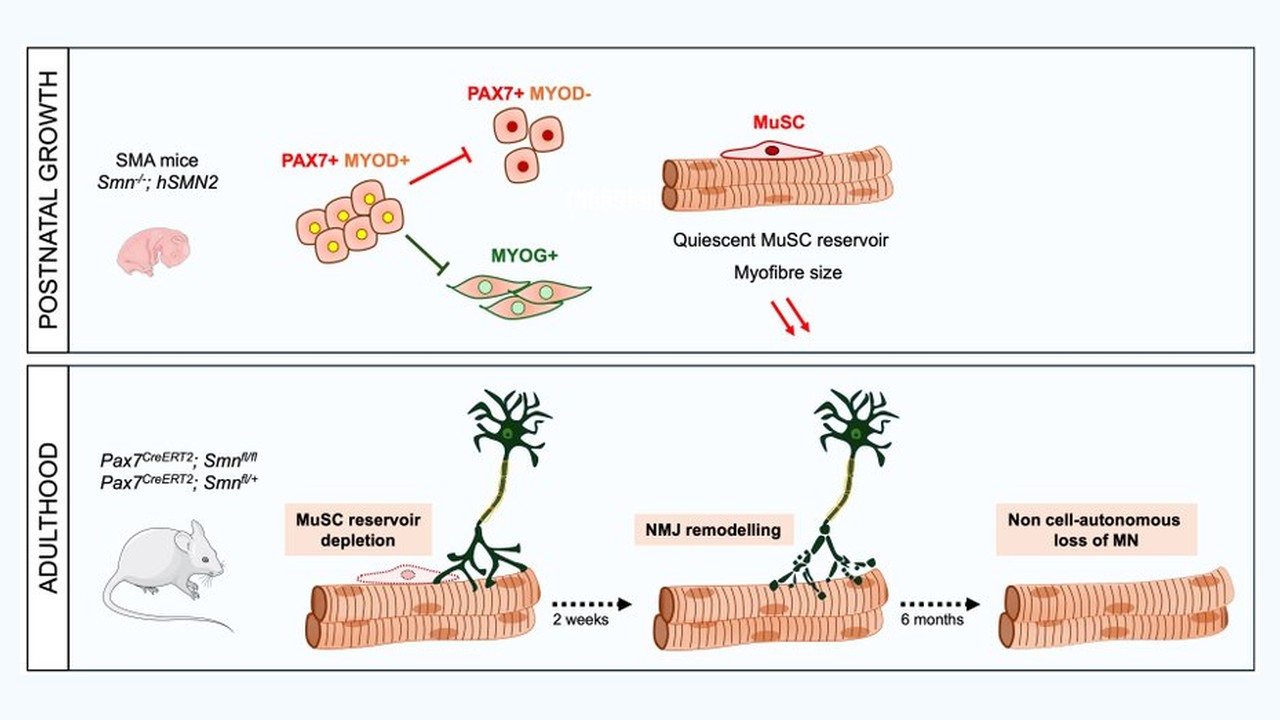
- Early postnatal growth (mice). In SMA mice (Smn−/−;hSMN2), SMN acted as an important regulator of myogenic progenitor fate. The SMN deficit disrupted the progression of PAX7+ MYOD+ progenitors through the myogenic programme and compromised the establishment of the quiescent MuSC reservoir.
- Adulthood (mice). The authors used Pax7-CreERT2 conditional knockout mice to delete Smn only in muscle stem cells. Losing a single Smn allele was enough to trigger apoptosis of quiescent MuSC in adult muscle. Their conclusion is that keeping the quiescent reservoir going takes high levels of SMN.
- From muscle to spinal cord. Depleting the MuSC reservoir led to neuromuscular junction (NMJ) remodelling within weeks. Over the long term, at around six months, part of the alpha motor neurons were lost. The loss is non-cell autonomous: the motor neurons themselves were not the cells in which Smn was knocked down. In a separate model, the team removed muscle stem cells with diphtheria toxin, without touching Smn, and also saw motor neurons decline.
- The authors' conclusion. Quiescent muscle stem cells and motor neurons depend on each other. MuSC may be important therapeutic targets for the long-term treatment of SMA, and their specific SMN requirements could inform next-generation combinatorial therapies.
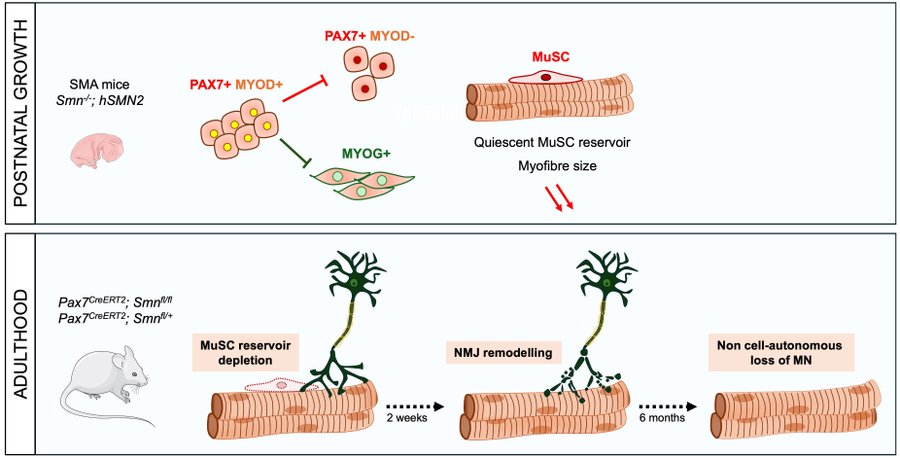
The figure that comes with the paper sums it up in two panels. During postnatal growth, the SMN deficit shifts how progenitors develop and leaves a smaller quiescent reservoir and smaller myofibres. In adulthood, depleting the reservoir leads to NMJ remodelling at about two weeks and to motor neuron loss at about six months.
What the paper doesn't say
Some limits belong here, in the spirit of the paper itself. The mechanistic work is in mice. The human data are a reduced count of stem cells in a small set of biopsies from untreated type II patients, and that is an association, not proof of the same causal chain in people. The study doesn't test any approved treatment, doesn't measure clinical outcomes in treated patients, and doesn't claim that current therapies fail. It raises a question about long-term durability. It doesn't answer one.
Why This Matters Commercially
From here on, everything is my commercial interpretation for rare disease teams in Europe, not a claim from the study.
1. The "neuron-only" narrative is incomplete
Much SMA communication, from disease-awareness material to the mode-of-action slide, still treats the motor neuron as the single story. This paper adds a second compartment that matters. If the muscle stem cell reservoir helps maintain the motor neurons over time, then where and how SMN is restored may matter for long-term outcomes. Those are the delivery route, the tissues reached and the timing. Teams that keep a neuron-only story risk sounding out of date to the neuromuscular specialists who read Brain.
That doesn't mean medical affairs should start making claims about muscle effects that their own product data don't support. It means the disease-education narrative should leave room for systemic biology, and field medical teams should be ready to discuss this paper accurately when KOLs raise it.
2. Value stories need to go beyond the first milestones
SMA's first value story was built on survival and early motor milestones. That was the right story for the first approvals. The next set of conversations with payers, HTA bodies and treating centres will be about years, not months: durability, residual weakness, function in adolescence and adulthood, and quality of life for patients and carers.
Science like this changes what "long-term" means. If disease biology continues in non-neuronal tissue, then long-term follow-up isn't just a regulatory box to tick. It's where the evidence for (or against) durability will come from. I made a similar point about real-world evidence and continuous monitoring in March's article on AI-driven medicine in rare disease care. Registries, outcome measures that capture fatigue and endurance, and well-designed patient support programmes all become strategic assets.
3. Combination thinking moves from theory to planning
The authors explicitly mention next-generation combinatorial therapies. SMA already has a body of work on SMN-independent approaches that target muscle. This study gives that logic another biological argument, focused on the stem cell reservoir rather than only on the mature muscle fibre.
For commercial and market access teams, combinations raise practical questions early. Who is the comparator when the add-on goes on top of an SMN-targeted backbone? How do you show added value on endpoints that are hard to measure in small, mixed populations? How will European payers view the budget impact of a second therapy in a disease that already has expensive treatments? None of this is new in rare disease, but SMA may be one of the first neuromuscular diseases where "on top of standard of care" becomes the main commercial question rather than a side issue.
4. KOL engagement shifts towards the integrated centre
Neuromuscular reference centres in Europe already bring together neurologists, neuropaediatricians, physiotherapists, orthopaedic surgeons and muscle pathologists. The biopsies in this study came from scoliosis surgery, a reminder that useful biology often sits outside the neurology clinic.
My view is that the most valuable scientific relationships in SMA over the next few years will be with teams that look at the whole neuromuscular unit: nerve, junction and muscle together. Medical affairs plans that map only neurology KOLs will miss part of that conversation.
5. Residual disease is a market, not a footnote
Treated patients who stabilise below their full potential are a growing population. That isn't a criticism of current therapies; it is the predictable result of their success. For companies developing the next wave of SMA treatments, this group is the core of the opportunity. It needs to be defined carefully, using natural history and real-world data rather than assumptions, and engaged early with patient organisations, who understand residual disability better than any forecast does.
What Commercial and Medical Teams Can Do Now
This is practitioner judgment from orphan launches, not evidence from the paper.
1. Audit your disease narrative. Read through the mode-of-action, disease-education and training material. Where does it imply that SMA is only about motor neurons? Change those places to reflect current science, within what your own label and data allow.
2. Brief field medical on the paper. A one-page, balanced summary of the findings and limitations means MSLs can respond accurately when neuromuscular experts raise it, without overclaiming in either direction.
3. Build long-term evidence into the plan, not onto it. Use outcome measures and registries that can capture durability, fatigue and function over years. If you're planning a European launch in neuromuscular disease, make this part of launch design from the start. (See our approach to orphan drug launches in Europe.)
4. Stress-test the combination case early. If your asset could be used alongside an SMN-targeted therapy, work through the comparator, endpoints and payer questions now, before the clinical plan locks them in.
5. Bring in the right expertise at the right time. Emerging biotechs moving a neuromuscular asset towards Europe often don't need a full affiliate yet. An experienced interim or fractional commercial lead can build the centre network, the evidence plan and the access strategy, then hand over or scale up. (That's the model behind our interim commercial director work in the Benelux.)
Key Takeaways
- SMA biology goes beyond the motor neuron. Mecca et al. show in mice that losing muscle stem cells leads to NMJ remodelling and then to non-cell-autonomous loss of alpha motor neurons.
- Muscle stem cells need high levels of SMN. In adult mice, losing one Smn allele in these cells was enough to cause apoptosis of quiescent MuSC.
- Human data are early but consistent. Untreated SMA type II patients had fewer quiescent PAX7+ muscle stem cells.
- The commercial story has to grow up. Durability, residual disease and combinations are where the next SMA value conversations will happen (interpretive).
- Evidence planning is strategy. Long-term, multi-tissue outcome data will decide which value stories hold up.
A Disease That Keeps Teaching Us
SMA has been one of rare disease's great success stories. It showed that a genetic understanding of a disease can lead to treatments that change lives, and it showed that more than once, with different approaches. It's also showing that the first answer is rarely the complete one.
Muscle stem cells won't replace the motor neuron at the centre of the SMA story. They make the story more complete. For the teams that bring the next generation of treatments to patients, getting that larger story right is part of the work.
Sources
1. Mecca J, Mignot J, Gervais M, Ozturk T, Astord S, Berthier J, Bauché S, Messéant J, Biferi MG, Rouard H, Barkats M, Relaix F, Didier N. "Targeted knockdown of Smn in muscle stem cells induces non-cell autonomous loss of motor neurons." Brain, 2026 (advance article, February 2026). https://doi.org/10.1093/brain/awag045 · PubMed: https://pubmed.ncbi.nlm.nih.gov/41644485/
2. European Medicines Agency. European public assessment reports for Spinraza (nusinersen), Zolgensma (onasemnogene abeparvovec) and Evrysdi (risdiplam). https://www.ema.europa.eu/